Pregnancy After 40:
Understanding Your Fertility With a Clearer Picture
Trying to get pregnant after 40 can quickly lead to a long list of terms,
tests, opinions and decisions.
This guide is designed to help you organize the most common topics—
from egg quality and AMH to hormone patterns and IVF—so you can approach
your fertility journey with clearer questions.
Searching for information about fertility after 40 can quickly become
overwhelming. Age, AMH, follicles, hormones, egg quality, treatment options
and personal history are often discussed as separate pieces.
A more useful way to approach the subject is to see those pieces as part
of one larger picture.
The purpose of this page is not to tell you what your fertility means.
It is to help you understand the vocabulary, organize the information
you already have and identify the questions you may want to explore further.
EGG QUALITY AFTER 40
What people mean when they talk about egg quality
“Egg quality” is one of the most frequently searched fertility terms,
especially among women exploring pregnancy after 40.
It is also a phrase that can mean different things depending on the context.
Online discussions may use it broadly when talking about reproductive age,
cellular biology, embryo development or fertility treatment.
For someone researching fertility, the important first step is often simply
to separate the concept of egg quality from other topics such as ovarian
reserve or the number of follicles visible on ultrasound.
Egg quality
A broad concept frequently discussed in relation to reproductive biology
and embryo development.
Ovarian reserve
A different concept related to the remaining follicle pool and measurements
used to describe it.
Your full picture
Age, cycle information, laboratory results, ultrasound findings and personal
history may all appear together in fertility conversations.
AMH AFTER 40
Understanding where AMH fits into the fertility conversation
AMH is one of the terms that appears repeatedly when people research
fertility after 40.
It is commonly discussed as one piece of information related to ovarian
reserve. But seeing one number without context can create more questions
than answers.
Instead of focusing only on whether a result is “high” or “low,” it can
be useful to organize AMH alongside other information you already have,
including dates, cycle information and ultrasound results.
FSH, LH, estrogen and progesterone are among the hormone names commonly
encountered while researching fertility.
One challenge is that fertility information often arrives at different
times: a blood test on one date, an ultrasound on another, and cycle
observations collected somewhere else.
Organizing those pieces into a timeline can make the information easier
to understand and easier to discuss.
Questions often become more useful than assumptions
“Getting pregnant after 40” is one of the most common ways people search
for information about this stage of fertility.
The answers found online can range from highly optimistic personal stories
to highly discouraging statistics. Neither extreme necessarily describes
an individual journey.
A more productive starting point is often to identify what you know,
what you do not know and what questions deserve further exploration.
Information you may want to organize
Cycle history
Previous fertility tests
AMH and other hormone results
Ultrasound findings
Previous pregnancies
Previous fertility treatments
Current medications or supplements
Questions you want to discuss at your next appointment
IVF AFTER 40
Understanding the language around fertility treatment
IVF is another major topic for people researching fertility after 40.
But IVF itself contains many separate concepts: stimulation, follicles,
retrieval, fertilization, embryo development and transfer.
Understanding that vocabulary can make it easier to follow a conversation
and to compare information from different sources.
Alejandra's approach is to organize those concepts into a broader biological
picture rather than treating each term as an isolated result.
Which results are most important in my specific situation?
How should I understand my AMH together with my other information?
Which results describe ovarian reserve and which describe something different?
What additional information would help complete the picture?
How should I organize previous tests and treatment results?
Which questions should I prioritize during my next appointment?
If IVF is being discussed, which stages and results should I understand?
ALEJANDRA'S 5-STEP FRAMEWORK
Turn scattered fertility information into a clearer picture
Alejandra Merino approaches fertility from the perspective of a chemical
engineer, senior scientist and woman navigating her own fertility journey
after 40.
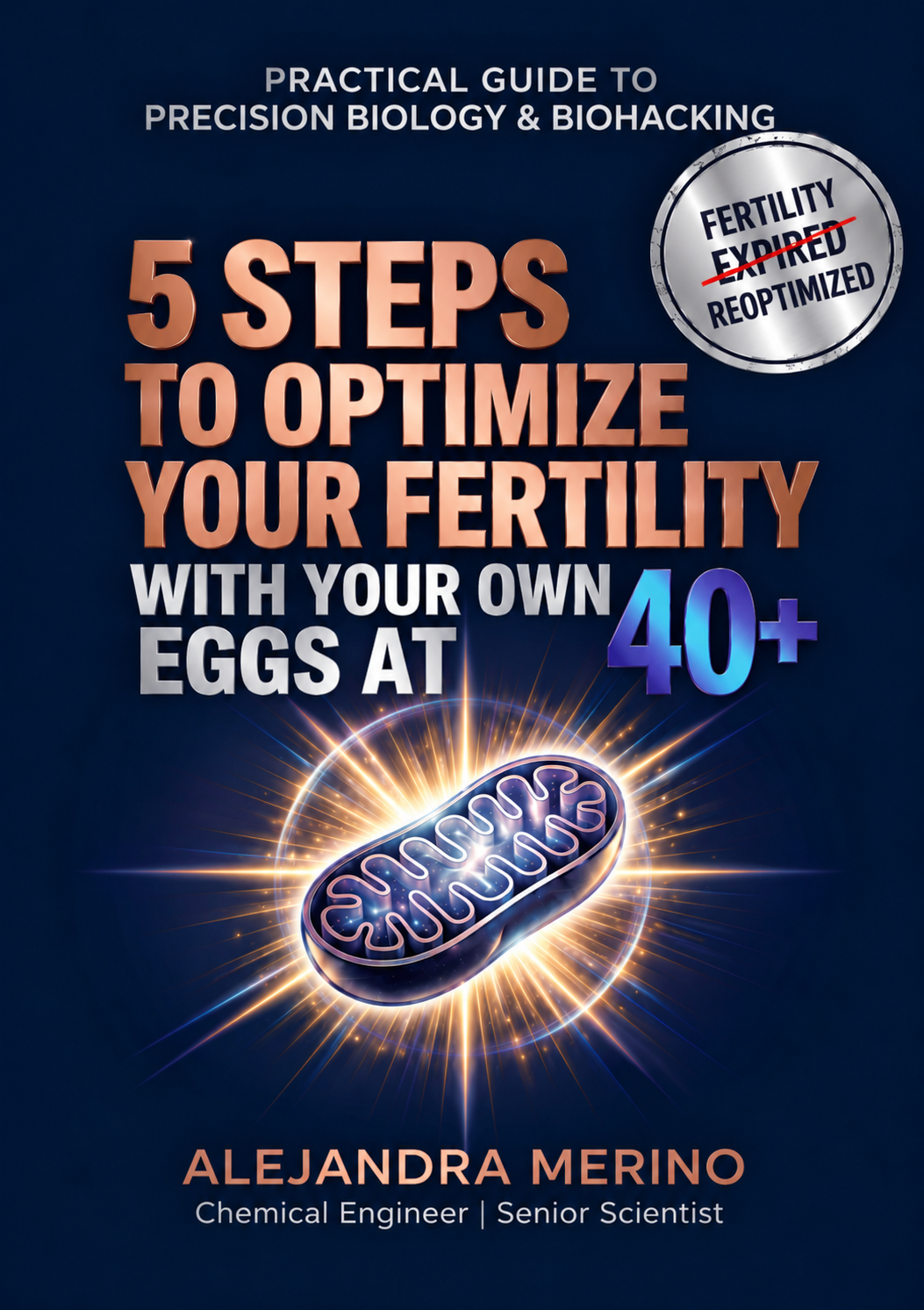
Her book,
5 Steps to Optimize Your Fertility With Your Own Eggs at 40+,
brings together hormone patterns, egg-quality biology, cellular energy,
fertility data and treatment conversations in one framework.
Fertility information can feel fragmented: one laboratory result here,
an ultrasound there, a new term you have never heard before, and a dozen
different opinions online.
My goal is to help women approach that information with curiosity,
structure and better questions.
This site shares educational information and personal perspective.
It does not replace individualized medical care.